Lab Sales CRM Workflow Reps Actually Keep
MedRoute Team
Founder, MedRoute AI
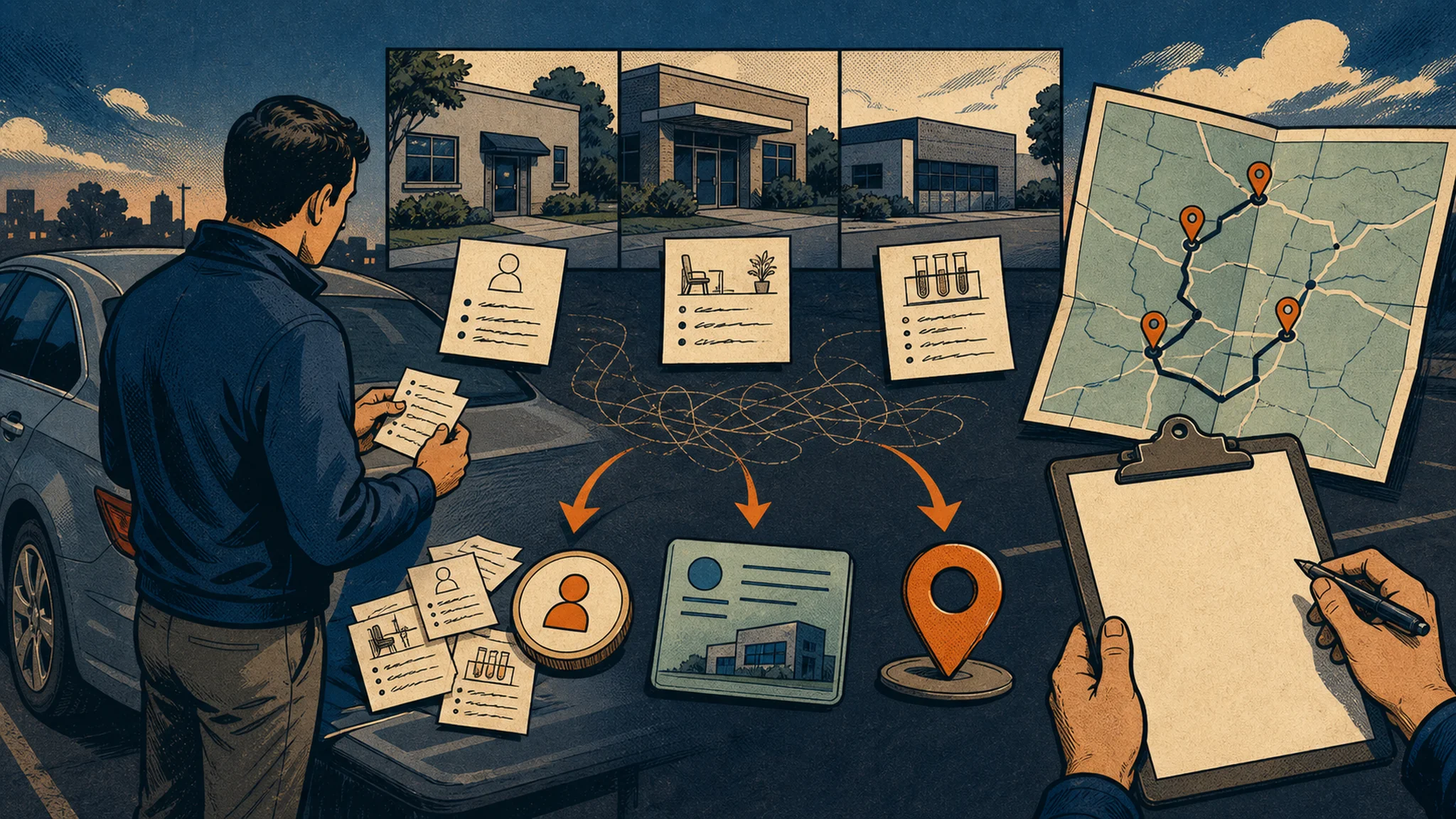
A lab sales CRM workflow should turn the last 2 minutes of a visit into the next route decision. A lab sales CRM workflow is the repeatable habit of capturing who was reached, what changed, what was promised, and what should move on the next route.
This post is for lab sales reps, diagnostic sales reps, and frontline managers who need call notes that actually survive a field day. If your account list and route live in MedRoute for lab sales reps, use the workflow below to keep follow-up close to the stop instead of rebuilding the story at night.
TL;DR
- Write the note for the next route, not for a perfect archive.
- Capture the role, change, promise, due window, and route impact.
- Review open promises before optimizing tomorrow's flexible stops.
- The artifact below turns a lab visit note into a next-action card.
Table of contents
- What is a lab sales CRM workflow?
- Why lab call notes fail after a busy route
- What should a lab sales rep put in CRM after a visit?
- Copyable lab visit note-to-route card
- How MedRoute keeps follow-up close to the route
What is a lab sales CRM workflow?
A useful CRM workflow starts before the rep opens the note field. The rep should know what the note has to decide: who gets follow-up, which account changes priority, which role still needs access, and whether the saved route loop should change. Anything else is optional.
Sales route optimization is the practice of sequencing stops, drive time, and account priority so reps spend more of the day on productive conversations. The CRM workflow should feed that sequence. If a physician office lab asked for a payer question by Thursday, that promise should affect the route before another convenient drop-in gets added.
What is a lab sales CRM workflow? A lab sales CRM workflow is a field routine that converts each visit into a clear note, follow-up window, route priority, and manager review signal. The U.S. Bureau of Labor Statistics describes outside sales representatives as traveling to customers and prospects, answering questions, arranging appointments, and handling follow-up after the sale. Lab reps also work around a regulated testing environment because CMS says CLIA regulates laboratory testing performed on humans in the United States. That mix makes a vague visit recap weak. The note has to preserve the next person, next promise, and next timing window. MedRoute helps when that note can shape the next route instead of sitting in a disconnected recap.
Why lab call notes fail after a busy route
Most bad call notes are written too late and for the wrong reader. A rep finishes 9 stops, drives home, opens the CRM, and tries to remember which front-desk handoff belonged to which office. The note becomes a diary because the decision moment already passed.
The better reader is tomorrow's rep. That person needs to know whether to call before arriving, bring kit material, ask for the office manager, skip the account until the lab director is available, or move the account above a cold stop. A manager can review that note too, but the field action comes first.
Keep the note tied to the field day
MedRoute is browser-based, built by field reps, and made for routes where account context and follow-up should change the next stop order.
Start a free MedRoute routeWhy do lab call notes fail after a busy route? They fail when the rep writes for record keeping instead of the next field decision. Outside sales work is already split between travel, appointments, customer questions, and reports, according to the U.S. Bureau of Labor Statistics. Lab selling adds role-specific timing: a POL office manager, urgent care operator, or reference lab contact may each need a different follow-up window. A note written 6 hours later can miss the small fact that should change tomorrow. A better note captures the account, role, promise, due window, and route impact inside 2 minutes. The CRM becomes useful when the note answers one question: what should happen before the next route is locked?
What should a lab sales rep put in CRM after a visit?
Put in the facts that change action. A lab rep does not need to write a novel about every stop. The note needs to show the role reached, the account signal, the follow-up promise, and the route consequence.
| Note field | Bad habit | Field-useful version | Route impact |
|---|---|---|---|
| Role reached | Talked to office | Office manager reached; lab director not available | Protect a director window next route |
| Account signal | Good visit | Asked about current send-out process and turnaround issue | Move account into priority block |
| Promise | Follow up soon | Send payer answer and call before Thursday lunch | Add 24 to 48 hour follow-up before cold stops |
| Route edit | Try again later | Best access appears early afternoon, not morning | Update saved loop timing |
If the team's weak point is follow-up discipline, pair this with the lab sales follow-up conversion rate guide. If the weak point is manager review, use the lab sales dashboard template after the note habit is clean.
Copyable lab visit note-to-route card
Use this immediately after a meaningful visit. It is intentionally small. If a rep cannot complete it from the car in about 2 minutes, it will not hold up on a real field day.
Lab visit note-to-route card
Date:
Account:
Facility type:

1. Who was reached?
- Role:
- Person or team:
- Role still missing:

2. What changed?
- Current issue or need:
- Objection or blocker:
- Account priority changed? Yes / No

3. What was promised?
- Rep promise:
- Account promise:
- Due window:
- Channel: call / email / return visit

4. What should the next route do?
- Move earlier:
- Add follow-up stop:
- Change saved loop timing:
- Manager review note:

5. Close the loop
- Done before leaving parking lot? Yes / No
- If no, exact time to finish today:
How MedRoute keeps follow-up close to the route
Follow-up slips when the note and the route live too far apart. The rep knows an account needs attention, but the route planner only sees addresses. The CRM knows a promise exists, but it does not decide stop order. The manager hears a recap, but not the route constraint.
MedRoute is built around the field sequence: plan a larger route, optimize the flexible stops, drag the order when account judgment wins, save a loop that worked, and keep account context close to the facilities. That means a note can become tomorrow's route action without asking the rep to maintain a separate spreadsheet.
How should CRM notes influence lab route planning? CRM notes should move the stops that depend on timing, priority, or a promised next step. Route optimization can arrange the flexible part of the day; Google Routes API documentation says waypoint optimization can reorder intermediate stops for a more efficient route when enabled. But an optimizer does not know that a lab director is only reachable after committee, that an office manager asked for a payer answer before lunch, or that a reference lab question is now older than 48 hours. Those facts belong in the CRM note. MedRoute keeps the note useful by letting account context, follow-up, drag-and-drop stop order, and saved routes stay close to one another. That is where field judgment beats a clean but blind route.
The bottom line
A lab sales CRM workflow works when it makes the next field move obvious. Capture the role, change, promise, due window, and route impact before the day blurs together. Then review the open promises before tomorrow's route gets optimized.
If your team is still building weekly coverage from scratch, use the lab sales route planning template alongside this note card. When you are ready to connect visit notes to the route itself, build the next route in MedRoute.
Frequently asked questions
What should a lab sales rep put in CRM after a visit?
A lab sales rep should put the account, role reached, current issue, promised next step, due window, and route impact in CRM after a visit. The note should be short enough to capture from the field and specific enough to tell the rep what to do next.
How do lab reps keep follow-up from slipping?
Lab reps keep follow-up from slipping by giving every real promise a due window, account owner, and next-route action before leaving the parking lot. If the follow-up should happen within 24 to 48 hours, it belongs ahead of cold drop-ins on the next route.
What makes a good lab visit note?
A good lab visit note names who was reached, what changed, what question or objection remains, and which action should happen next. It avoids diary-style recap. The best note can be read by the rep or manager and turned into a route decision quickly.
How should lab reps manage CRM without losing field time?
Lab reps should manage CRM with a small field habit: capture the next action first, add only account context that changes follow-up, and review open promises before building the next route. Keep the system useful for selling, not perfect for admin cleanup.
About the author
Brandon Worley
Brandon Worley is the founder of MedRoute AI. He carried a territory as a field medical sales rep, then built and ran a 450-person medical sales team. Today he trains medical sales reps and teams full-time, and built MedRoute from the pain points he and the reps he trains experienced in the field every day.
Connect on LinkedInKeep reading
Lab Sales Follow Up Timing: Same Day or Next Day?
A field-ready timing framework for lab reps deciding which visit promises deserve same-day follow-up and which belong in the next route.
ReadCall Notes & CRMLab Sales Call Notes Checklist for Clear Next Steps
A pass-or-rewrite checklist for lab reps who need call notes to survive the next drive segment, manager review, and tomorrow morning route plan.
ReadWant these tactics easier to execute?
MedRoute AI is the tool Brandon built to make every tactic in this library 10x easier.