Lab Sales Follow Up Timing: Same Day or Next Day?
MedRoute Team
Founder, MedRoute AI
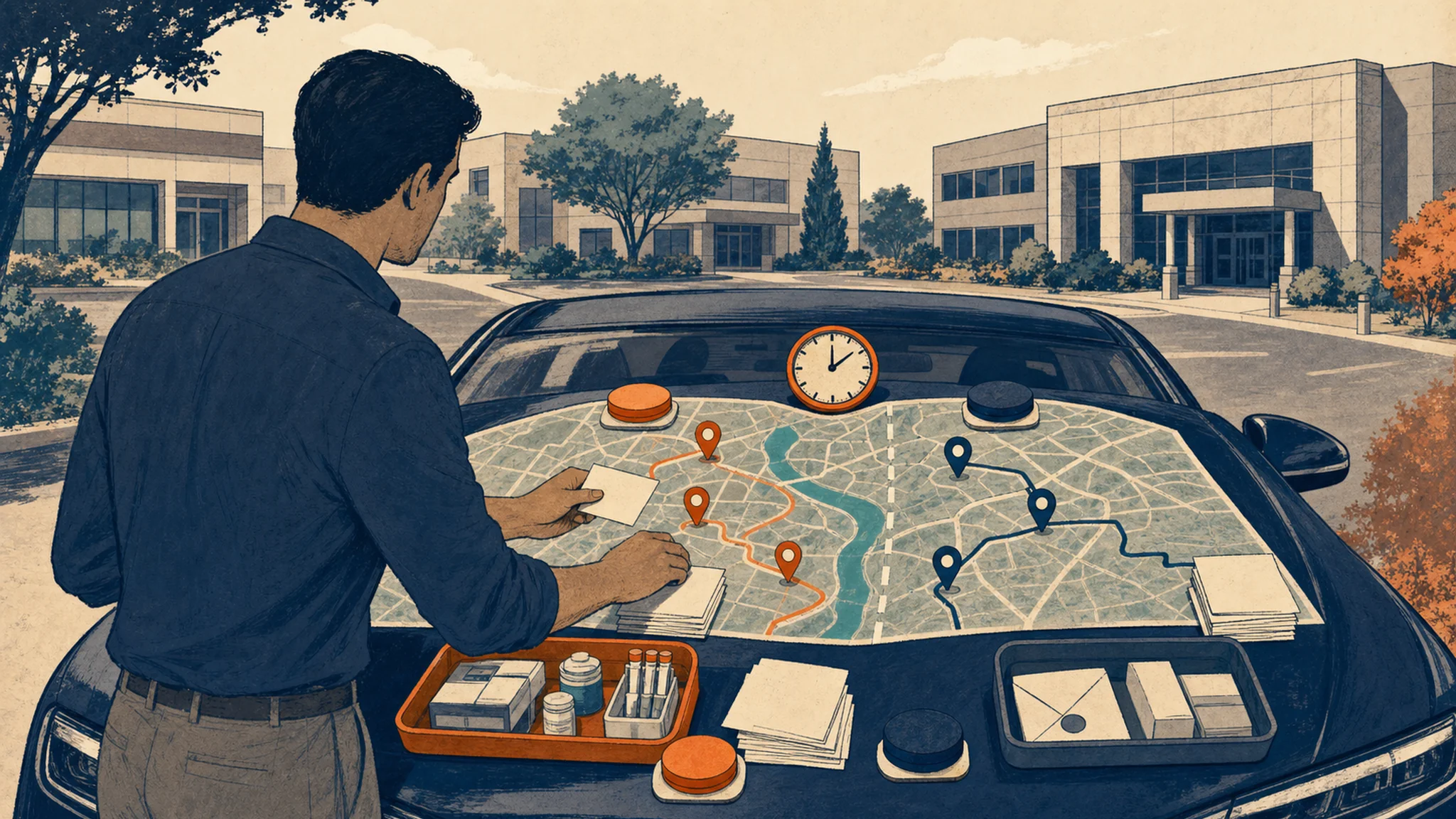
Lab sales follow up timing is the field decision that separates a warm promise from another note you hope to remember later. It is the habit of deciding whether a follow-up belongs today, tomorrow, or in background context before the route moves on.
Sales route optimization is the practice of sequencing stops, drive time, and account priority so reps spend more of the day on productive conversations. This post is for lab sales reps, diagnostic sales reps, and managers who need follow-up discipline without turning every note into a fire drill. If your account list already lives in MedRoute for lab sales reps, use this timing framework before you build the next route.
TL;DR
- Same-day follow-up is for fresh motion, risk, or promised answers due today.
- Next-day follow-up is for planned route windows, not vague delay.
- Every CRM note should name the channel, due window, and route impact.
- The artifact below turns follow-up timing into a routing decision.
Table of contents
- What is lab sales follow up timing?
- When same-day follow-up is worth interrupting the route
- When next-day follow-up is the better move
- Lab sales follow up timing decision grid
- Copyable follow-up timing triage card
- How MedRoute turns timing into the next route
What is lab sales follow up timing?
Timing is not just "fast is good." A rep who treats every promise like a same-day emergency loses the route. A rep who pushes every promise to tomorrow teaches the account that follow-up is loose. The useful question is narrower: will this action protect account motion if it happens today, or will it land better when it is tied to the next route?
That question keeps CRM practical. A payer answer promised by 5 p.m., a specimen kit issue blocking tomorrow's pickup, or a lab director callback with a live window should not wait. A planned office manager check-in, route revisit, or non-urgent provider handoff may work better when it is placed in tomorrow's call block or saved loop.
What is lab sales follow up timing? It is the decision rule that tells a rep whether a visit promise needs same-day action, next-day action, or background CRM context. The U.S. Bureau of Labor Statistics describes outside sales representatives as traveling to customers and prospects, answering questions, arranging appointments, and handling follow-up after the sale. Lab reps also work around regulated testing operations because CMS says CLIA regulates laboratory testing performed on humans in the United States. That mix makes timing more than politeness. A same-day response can protect a live issue or role window, while next-day follow-up can preserve route focus when the promise belongs with the next account touch. MedRoute matters when the timing bucket changes the route, not just the note. Managers also get a cleaner review trail from field promise to route action.
When same-day follow-up is worth interrupting the route
Same-day follow-up earns the interruption when the account is already moving. Think about a POL office manager waiting on a payer answer before the provider conversation, an urgent care contact asking for a kit clarification before tomorrow morning, or a reference lab contact who finally gives you a callback window after 3 missed attempts.
The rep test is simple: if waiting until tomorrow would force you to rebuild context or lose the person who can act, follow up today. Do it in the channel the account already accepted. Then update the note so the next route reflects what happened.
Put warm promises ahead of cold stops
MedRoute is browser-based, built by field reps, and made for routes where follow-up timing should change the next stop order.
Start a free MedRoute routeWhen should a lab rep follow up the same day? Same-day follow-up belongs when the visit created fresh motion that could decay before the next route is built. A sales rep's day already includes travel, appointments, customer questions, follow-up, reports, and route planning, according to the U.S. Bureau of Labor Statistics. Lab selling adds timing pressure because access can depend on a specific role, office rhythm, or testing-process question. If a rep owes an answer today, needs to confirm a next-morning kit detail, or finally reaches the right person after several misses, waiting can create extra work. Same-day action should still be specific: account, role, channel, due window, and note update. It is not a license to blow up the route after every conversation. It is a way to protect the few promises that should not cool off.
When next-day follow-up is the better move
Next-day follow-up is not procrastination when it is planned. It is the right move when the account needs a cleaner handoff, the rep needs one piece of prep, or the stop belongs with a route window that will already put the rep nearby.
A lab director who asked for a short check-in "tomorrow afternoon" belongs on tomorrow's route. So does an office manager who wants a 10-minute update after lunch, or a provider conversation that should happen after the rep confirms the account history. The discipline is to schedule it before you drive away, not to leave it as a soft reminder.
If the team is still struggling with what belongs in the note at all, pair this timing decision with the lab sales call notes checklist. If the issue is the raw note format, use the lab sales visit note template first.
Lab sales follow up timing decision grid
Use the grid before you add another stop. It keeps the decision tied to account motion, not guilt, optimism, or a manager's Friday recap.
| Visit signal | Same-day move | Next-day move | Route impact |
|---|---|---|---|
| Promised answer due today | Send or call before the last drive segment | Only if the account agreed to tomorrow | Protect the warm account before cold visits |
| Right role finally reached | Confirm the next step while access is fresh | Route back during the role's stated window | Move the account into a priority block |
| Non-urgent office check-in | Skip unless it prevents confusion today | Add to tomorrow's call block or route loop | Avoid breaking a planned 6-stop day |
| Service or logistics concern | Act today if it blocks tomorrow's account motion | Review next day if action depends on prep | Flag the stop before route optimization |
Copyable follow-up timing triage card
Use this after any visit that creates a real promise. It should take about 2 minutes. If it takes longer, the promise is probably still too vague.
Lab sales follow-up timing triage card
Account:
Role reached:
Role still needed:

1. Promise
- What did I promise?
- What did the account ask for?
- Channel accepted: call / email / return visit

2. Timing bucket
- Same day if waiting loses context, access, trust, or tomorrow's setup.
- Next day if it belongs with a planned call block or route window.
- Background if no account action changes.

3. Route impact
- Interrupt today's route? Yes / No
- Move earlier tomorrow? Yes / No
- Add to saved loop? Yes / No
- Manager review needed? Yes / No

4. Before driving
- Due window entered:
- Next route updated:
- Note rewritten if the timing is still unclear:
The card is different from a normal CRM template. It does not ask for a longer recap. It forces the rep to decide whether the note should interrupt today or shape tomorrow.
How MedRoute turns timing into the next route
Follow-up timing gets weaker when the reminder and the route live apart. The note says "call tomorrow," but the route planner only sees addresses. The rep optimizes mileage, then realizes the warm account is now behind three convenient cold stops.
MedRoute fits after the timing decision: build a larger route, optimize the flexible stops, drag a same-day or next-day priority ahead when field judgment wins, and save the loop that worked. The point is not to make every follow-up urgent. The point is to keep timing close enough to the route that the promise can actually happen.
How should route tools support lab sales follow-up timing? Route tools should arrange drive time while still giving the rep room to move timing-sensitive follow-up ahead of ordinary stops. Google Routes API documentation says waypoint optimization can reorder intermediate stops for a more efficient route when enabled. That helps with the movable part of a field day, but it does not know that a POL manager needs a same-day payer answer, that a lab director is available tomorrow after lunch, or that a kit question could affect the next pickup. Those facts live in the visit note. MedRoute helps by keeping route optimization, drag-and-drop reorder, saved routes, account context, and manager visibility close enough for timing to become a route action instead of a reminder the rep rediscovers too late. The route stays practical because the timing decision has a place to live.
The bottom line
Lab sales follow up timing works when the rep protects fresh motion without turning the route into chaos. Same-day follow-up is for promises that lose value if they wait. Next-day follow-up is for planned action that belongs in the next call block or route window.
If your team needs the larger workflow around those timing calls, start with the lab sales CRM workflow guide. When you are ready to turn follow-up timing into the field day itself, build your next route in MedRoute.
Frequently asked questions
What should a lab sales rep put in CRM after a visit?
A lab sales rep should put the account, role reached, promise, due window, channel, and route impact in CRM after a visit. For timing, add whether the follow-up is same-day, next-day, or background context so tomorrow's route does not bury a warm promise or vague recap.
How do lab reps keep follow-up from slipping?
Lab reps keep follow-up from slipping by assigning every promise a timing bucket before they drive away. Same-day follow-up protects urgent account motion. Next-day follow-up belongs on the next route or call block. Anything without a due window should not be treated as real follow-up.
What makes a good lab visit note?
A good lab visit note tells the rep when to act, not only what happened. It names the account, role, issue, promised next step, due window, and route consequence. If the note cannot answer same-day or next-day, it is not ready for field use.
How should lab reps manage CRM without losing field time?
Lab reps should manage CRM with a small timing habit: capture the promise, assign the bucket, and let only true same-day items interrupt the route. Next-day items should move into tomorrow's plan so CRM supports selling time instead of swallowing it during account coverage.
About the author
Brandon Worley
Brandon Worley is the founder of MedRoute AI. He carried a territory as a field medical sales rep, then built and ran a 450-person medical sales team. Today he trains medical sales reps and teams full-time, and built MedRoute from the pain points he and the reps he trains experienced in the field every day.
Connect on LinkedInKeep reading
Lab Sales Call Notes Checklist for Clear Next Steps
A pass-or-rewrite checklist for lab reps who need call notes to survive the next drive segment, manager review, and tomorrow morning route plan.
ReadCall Notes & CRMLab Sales Visit Note Template for Fast Logging
A parking-lot-ready visit note template for lab reps who need CRM notes to preserve the next person, promise, and route move without stealing field time.
ReadWant these tactics easier to execute?
MedRoute AI is the tool Brandon built to make every tactic in this library 10x easier.