Lab Sales Visit Note Template for Fast Logging
MedRoute Team
Founder, MedRoute AI
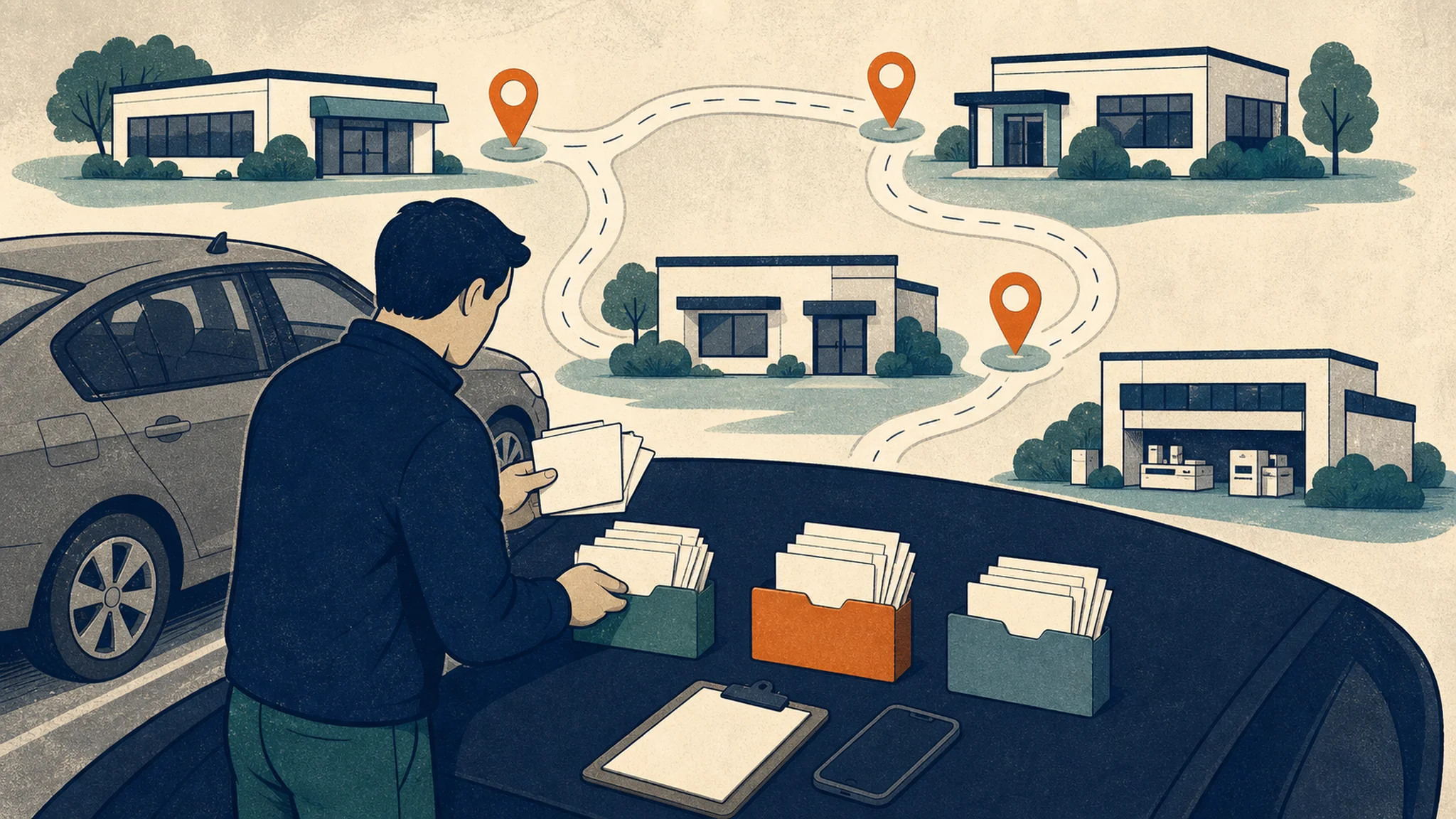
A lab sales visit note template should take less time than finding your next address. A lab sales visit note template is a short field logging format that captures who you reached, what mattered, what was promised, and whether tomorrow's route should change.
This post is for lab sales reps, diagnostic sales reps, and managers who want useful CRM notes without turning the parking lot into a paperwork shift. If your accounts and routes already live in MedRoute for lab sales reps, use the template below before the day starts blurring together.
TL;DR
- Keep the note to 5 fields: account, person, signal, promise, route effect.
- Write it before the next drive segment, not after dinner.
- Separate useful CRM detail from diary-style recap.
- The copyable template below is built for a 90-second parking-lot entry.
Table of contents
- What is a lab sales visit note template?
- Why the note has to fit the parking lot
- What should a lab sales rep put in CRM after a visit?
- Copyable 90-second lab visit note template
- How the template changes tomorrow's route
What is a lab sales visit note template?
The template is a decision aid, not a journal. It should give tomorrow's version of you enough context to call the right person, protect the right access window, and move the right account ahead of a convenient drop-in.
Sales route optimization is the practice of sequencing stops, drive time, and account priority so reps spend more of the day on productive conversations. A visit note helps that sequence only when it records facts that can change the next call, stop, or saved loop.
What is a lab sales visit note template? It is a field-ready format that turns a lab visit into a short CRM record and a next-route decision. The U.S. Bureau of Labor Statistics describes wholesale and manufacturing sales representatives as traveling to customers, contacting accounts, arranging appointments, answering questions, and following up after the sale. Lab reps also work in a regulated testing environment because CMS says CLIA regulates laboratory testing performed on humans in the United States. That mix makes vague notes risky. A useful note preserves the account, role reached, business signal, promise, due window, and route effect while the visit is still fresh. For a rep covering 7 or 8 stops, the template is the handoff between memory and action. MedRoute helps when those details can sit close to the route instead of becoming another disconnected recap.
Why the note has to fit the parking lot
A lab route can move fast: a POL drop-in, a reference lab check, an urgent care follow-up, then 18 minutes across town before the office manager leaves for lunch. If the note takes 10 minutes, reps will skip it. If it waits 6 hours, the small detail that mattered is gone.
The better rule is simple: write the note before you put the car in drive. It does not need every sentence you would tell a manager. It needs the one signal that changes what happens next.
Keep the note close to the stop
MedRoute is browser-based, built by field reps, and made for routes where account context and follow-up should shape the next stop order.
Start a free MedRoute routeWhy should lab reps log the note before the next drive segment? The note is more accurate when it is captured while the role, promise, and access clue are still fresh. The U.S. Bureau of Labor Statistics lists travel, customer contact, appointment scheduling, reports, and follow-up among the work of sales representatives. A lab rep has the same pressure with lab-specific timing layered on top: a specimen question, director access window, or office-manager handoff can change the next 24 to 48 hours. A 90-second note protects that signal before the route moves on. That is especially true when the next account is only a few miles away and the rep is already shifting talk tracks. If the rep waits until night, the CRM entry may sound complete but miss the detail that should have changed tomorrow's route.
What should a lab sales rep put in CRM after a visit?
Put in the smallest set of facts that can change action. The template should help a rep decide whether to call, return, move the account earlier, lower the priority, or ask a manager for help.
| Field | Write this | Skip this | How it changes the route |
|---|---|---|---|
| Person or role | Office manager reached; provider still missing | Talked to office | Try the provider window before adding cold stops |
| Account signal | Asked about send-out turnaround and payer mix | Good conversation | Move the account into a priority block |
| Promise | Send answer by Thursday morning, then call | Follow up soon | Add a 24 to 48 hour follow-up before new visits |
| Route flag | Afternoon access is better than morning access | Stop was okay | Change the saved loop timing |
If the team needs the larger operating system around notes, read the lab sales CRM workflow guide. If the weak point is what happens after the note, pair this with the lab sales follow-up conversion rate guide.
Copyable 90-second lab visit note template
Use this after any visit that creates a real next step. It is short on purpose. A rep should be able to complete it in the parking lot before the next drive segment starts.
Lab sales 90-second visit note template

One-line CRM note:
[Account] | [Role reached / still needed] | [Signal] | [Promise + due window] | [Route effect]

Field picklist:
- Role: office manager / provider / lab director / front desk / billing contact
- Signal: access window / turnaround concern / payer question / kit need / expected volume / no real motion
- Promise: send answer / call / email / return visit / manager review
- Route effect: move earlier / protect window / keep on loop / lower priority / add follow-up

Examples:
- POL: office manager reached; provider still needed | payer question | send answer by Thu AM | add call before new drop-ins
- Urgent care: operator reached | kit process unclear | return with kit sheet next route | protect afternoon window
- Reference lab: lab director missed | turnaround concern still active | call before Friday | keep account on saved loop

Before driving:
- Is the next action dated?
- Did the route effect get added where tomorrow's route is planned?
The final check matters. It forces the rep to turn the line into a dated action before the day steals the detail.
How the template changes tomorrow's route
A visit note earns its keep when it changes the next route. The route planner can sequence addresses, but the rep still has to decide which accounts deserve time, which promises are warm, and which access windows are worth protecting.
MedRoute fits the handoff after the note is captured: build a larger route, optimize the movable stops, drag priority follow-up earlier when field judgment wins, and save a route loop that worked. The note does not need to become a separate spreadsheet.
How should visit notes influence route planning? Visit notes should move stops when they reveal timing, priority, or a promised next step. Google Routes API documentation says waypoint optimization can reorder intermediate stops for a more efficient route when enabled. That is useful for the flexible part of a field day, but it cannot know that a provider asked for a callback before lunch or that a reference lab question is now older than 48 hours. The note supplies that field judgment. MedRoute gives reps a practical way to keep route optimization, drag-and-drop order changes, saved loops, account context, and manager visibility close enough that a note can become tomorrow's route move. The best template marks the difference between a routing constraint and background noise, so route changes stay tied to account reality, not only mileage.
If you already have a weekly loop, use this template beside the lab sales route planning template. The route template chooses where the day goes. The visit note template decides what the next version of that route should remember.
The bottom line
A lab sales visit note template works when it makes the next field move obvious. Capture the person, signal, promise, due window, and route effect before the next drive segment. Then let the best notes change the next route instead of collecting dust in CRM.
When you are ready to keep notes, account context, and route planning closer together, build your next route in MedRoute.
Frequently asked questions
What should a lab sales rep put in CRM after a visit?
A lab sales rep should put the account, person or role reached, business signal, promised follow-up, due window, and route effect in CRM after a visit. Skip diary details unless they change the next action, account priority, or manager coaching question.
How do lab reps keep follow-up from slipping?
Lab reps keep follow-up from slipping by logging the promise before the next drive segment, assigning a due window, and reviewing those promises before building tomorrow's route. If a note cannot change a call, stop, or route order, it is probably too vague.
What makes a good lab visit note?
A good lab visit note is short, specific, and route-aware. It names who was reached, what signal matters, what was promised, when it is due, and whether the next route should change. It should be readable in under 30 seconds.
How should lab reps manage CRM without losing field time?
Lab reps should manage CRM by using a small field template, saving longer cleanup for true exceptions, and keeping account context close to route planning. The goal is not perfect prose. The goal is a next step that survives the field day.
About the author
Brandon Worley
Brandon Worley is the founder of MedRoute AI. He carried a territory as a field medical sales rep, then built and ran a 450-person medical sales team. Today he trains medical sales reps and teams full-time, and built MedRoute from the pain points he and the reps he trains experienced in the field every day.
Connect on LinkedInKeep reading
Lab Sales Call Notes Checklist for Clear Next Steps
A pass-or-rewrite checklist for lab reps who need call notes to survive the next drive segment, manager review, and tomorrow morning route plan.
ReadCall Notes & CRMLab Sales Follow Up Timing: Same Day or Next Day?
A field-ready timing framework for lab reps deciding which visit promises deserve same-day follow-up and which belong in the next route.
ReadWant these tactics easier to execute?
MedRoute AI is the tool Brandon built to make every tactic in this library 10x easier.