Reference Lab Sales Route Planning Loops That Hold
MedRoute Team
Founder, MedRoute AI
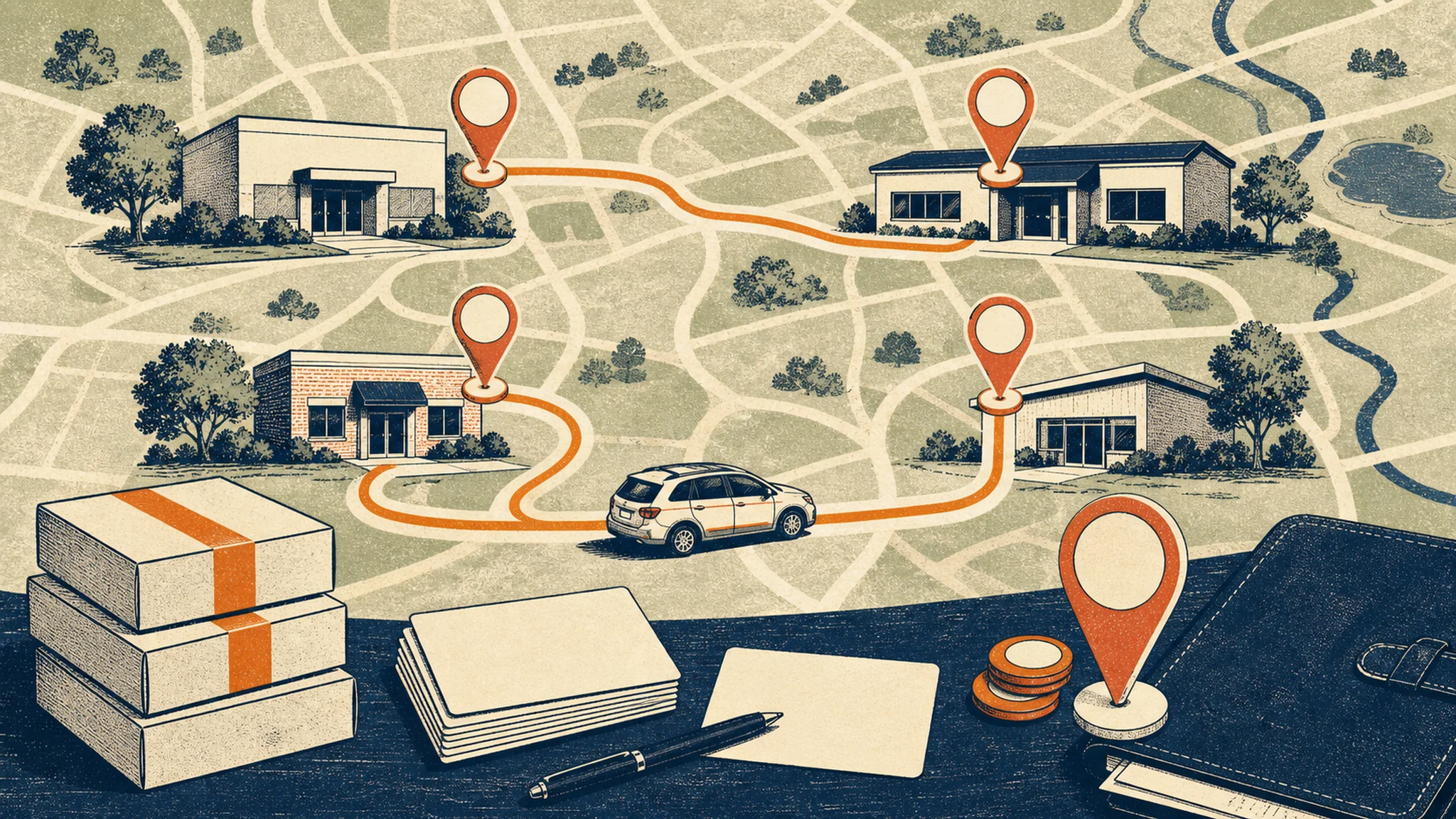
Reference lab sales route planning lives or dies on the follow-up window. Reference lab sales route planning is the process of sequencing reference lab, POL, urgent care, and follow-up stops so fixed account promises stay protected before mileage gets optimized.
This post is for reference lab reps, diagnostic sales reps, POL sellers, and managers who need the route to respect pickup-related conversations, lab director access, and same-day callbacks. If your account list is ready but the loop keeps changing from the car, MedRoute for lab sales reps can help turn the movable stops into a route without burying rep judgment.
TL;DR
- Reference lab routes should start with follow-up windows, not closest-first mileage.
- Hard windows are fixed; soft windows can move only inside a realistic time band.
- Separate pickup-related promises, lab director access, and POL checks before routing.
- Use MedRoute to optimize the movable stops, drag the order, and save loops that work.
Table of contents
- What is reference lab sales route planning?
- Why follow-up windows should beat closest-first routing
- Separate hard and soft windows
- Copyable follow-up window worksheet
- How MedRoute keeps the loop reusable
- Frequently asked questions
What is reference lab sales route planning?
Reference lab reps work routes where the next step can matter more than the address. A POL office manager might need a kit conversation before lunch. A lab director might only have a clean 9:15 a.m. opening. An urgent care manager might ask for a callback once morning volume settles.
The route should make those windows visible before the rep asks any tool to order the drive. The earlier Academy guide to lab sales route planning templates covers the weekly planning layer. This article narrows the workflow to the reference lab loop that has to protect follow-up while still leaving room for flexible stops.
What is reference lab sales route planning? It is the route-planning habit that puts access windows, pickup-related promises, lab director conversations, and account follow-up ahead of closest-first mileage. The U.S. Bureau of Labor Statistics describes wholesale and manufacturing sales representatives as traveling to current customers and prospects while also handling appointments, client issues, reports, and travel planning. CMS says the Clinical Laboratory Improvement Amendments program applies to laboratory testing performed on humans in the United States, which is the operating environment many lab reps sell into. That combination matters because a reference lab rep is not just moving between addresses. The route may include a 9:15 a.m. lab director opening, a 20-minute POL kit conversation, and an afternoon result follow-up. MedRoute helps after the rep names those constraints: it turns the facility list into a larger route, keeps the order editable, and lets the loop be saved for the next territory pass.
Why follow-up windows should beat closest-first routing
Closest-first routing feels clean until the closest account is the wrong account. Reference lab reps often carry promises from the last visit: check back after a pickup issue, ask the office manager about ordering flow, or catch a lab director before the next staff block.
Those windows should shape the loop. Put hard windows on the route first. Give soft windows a range. Then let the flexible POL, urgent care, and independent practice stops fill the space. If the route outgrows a simple map, the guide to the Google Maps stop limit for lab sales explains why splitting by hand can break the account logic.
Try the loop before the map
MedRoute is browser-based, built by field reps, and made for multi-stop healthcare routes that need more than closest-first driving.
Plan your first routeWhy should follow-up windows beat closest-first routing? Because the stop that protects an account promise can be more valuable than the stop sitting 1.2 miles closer. The U.S. Bureau of Labor Statistics notes outside sales reps often travel to customers and prospects and spend time on appointment and report work, so every route decision competes with admin and drive time. In a reference lab territory, the follow-up might be a promised office-manager callback, a lab director question, or a conversation about a specimen workflow issue. If that window is available from 10:00 to 10:20 a.m., a shortest-route order that arrives at 11:05 a.m. missed the actual job. MedRoute does not decide which promise matters. The rep does. The workflow is to label hard windows, identify soft windows, and then optimize the stops that can move. That keeps the route from punishing the account with the clearest next step.
Separate hard and soft windows
A hard window is a stop that breaks if the rep arrives outside the time. A soft window is still time-sensitive, but it can move inside a realistic band. The mistake is treating both like ordinary pins.
| Window type | Reference lab field signal | Route move | MedRoute habit |
|---|---|---|---|
| Hard window | Lab director gave a narrow meeting time | Place before optimization | Keep visible, then reorder flexible stops around it |
| Soft window | Office manager asked for a callback after patient rush | Set an arrival band | Drag the stop if the morning changes |
| Operational follow-up | Pickup, kit, or ordering issue needs a same-day touch | Rank above cold drop-ins | Save the account context with the loop |
| Flexible stop | Nearby POL, urgent care, or activation target | Let optimization order it | Save the loop if the pattern works |
This is the practical difference between a reference lab route and a generic errand list. The route has to preserve the promise first, then make the drive efficient.
Copyable follow-up window worksheet
Use this before building tomorrow's route. Keep it short enough to finish in 7 minutes. If the worksheet feels like another CRM chore, it will not survive the first parking-lot reset.
Reference lab follow-up window worksheet
Date:
Territory segment:

1. Hard windows
- Account:
- Time:
- Person or role:
- Why missing this window hurts:

2. Soft follow-up windows
- Account:
- Best arrival band:
- Promise from last visit:
- Can move after:

3. Pickup, kit, or ordering follow-up
- Account:
- Issue:
- Needed by:
- Note to capture:

4. Flexible nearby stops
- POLs:
- Urgent cares:
- Independent practices:
- Activation targets:

5. Route build
- Stops to lock first:
- Stops MedRoute should optimize:
- Stop likely to move if access changes:
- Loop worth saving:
For a tool-choice view, read the comparison of lab sales route planning vs Google Maps. For this specific loop, the decision point is narrower: which follow-up promise controls the next route?
How MedRoute keeps the loop reusable
MedRoute fits after the rep has separated the windows. Add the fixed stops, keep the account context visible, and let the flexible stop list move. Then drag the order when field judgment beats the default route.
The saved route matters because reference lab territories repeat. A good Tuesday loop should not disappear after one drive. Reload it next month, remove the accounts that went cold, add the new follow-up, and keep the working shape.
How should route optimization fit a reference lab route loop? Route optimization should order flexible stops after the rep has separated hard windows from movable calls. Google Routes API documentation says waypoint optimization can rearrange intermediate stops for a more efficient route when an application enables that capability. That is useful, but the optimizer does not know that a lab director agreed to 15 minutes before a staff meeting or that a POL manager asked for a callback after morning patients clear. MedRoute uses Google Maps directions and waypoint optimization, supports large routes in practical chunks around 25 waypoints, and gives the rep drag-and-drop reorder plus saved routes. The clean handoff is simple: rep judgment sets the windows, MedRoute orders the movable stops, and the rep saves the loop that worked. That balance is the difference between a pretty map and a route the territory can repeat.
The bottom line
Reference lab sales route planning works when follow-up windows come before mileage. Lock the lab director opening, protect the pickup-related promise, group the flexible stops, and save the loop that held up. When the next reference lab day has too many moving pieces for a quick map, build the route in MedRoute.
Frequently asked questions
How do lab sales reps plan territory routes?
Lab sales reps plan territory routes by naming fixed access windows first, then batching flexible nearby accounts. For reference lab reps, that means lab director openings, POL kit conversations, pickup-related promises, and urgent follow-up should shape the route before mileage or closest-first driving.
What is the best route planning method for lab reps?
The best method is constraint-first planning. Mark hard windows, soft follow-up windows, and priority accounts before optimizing the drive order. Then use route optimization for the stops that can move. That keeps a reference lab loop tied to account value, not only road distance.
How many lab accounts can a rep visit in one morning?
A realistic morning is often 3 to 5 lab accounts, depending on drive time, visit length, and access. A reference lab rep can fit more short POL stops when they are clustered, but one lab director meeting or specimen workflow issue can quickly reshape the morning.
Should lab reps optimize by mileage or account priority first?
Lab reps should optimize by account priority first when a stop has a narrow access window, promised follow-up, or business value. Mileage comes after those constraints. A shorter route can still miss the account that needed a 15-minute lab director conversation or same-day callback.
About the author
Brandon Worley
Brandon Worley is the founder of MedRoute AI. He carried a territory as a field medical sales rep, then built and ran a 450-person medical sales team. Today he trains medical sales reps and teams full-time, and built MedRoute from the pain points he and the reps he trains experienced in the field every day.
Connect on LinkedInKeep reading
Lab Sales Route Planning Template for Weekly Territory Loops
A practical weekly template for lab reps who need to protect fixed account windows, group flexible stops, and save repeatable territory loops.
ReadRoute PlanningLab Sales Route Planning vs Google Maps
A practical comparison for lab reps deciding when Google Maps is enough and when a field-sales route planner is the better fit for territory days.
ReadWant these tactics easier to execute?
MedRoute AI is the tool Brandon built to make every tactic in this library 10x easier.