Lab Sales Territory Planning 2026: What Changed
MedRoute Team
Founder, MedRoute AI
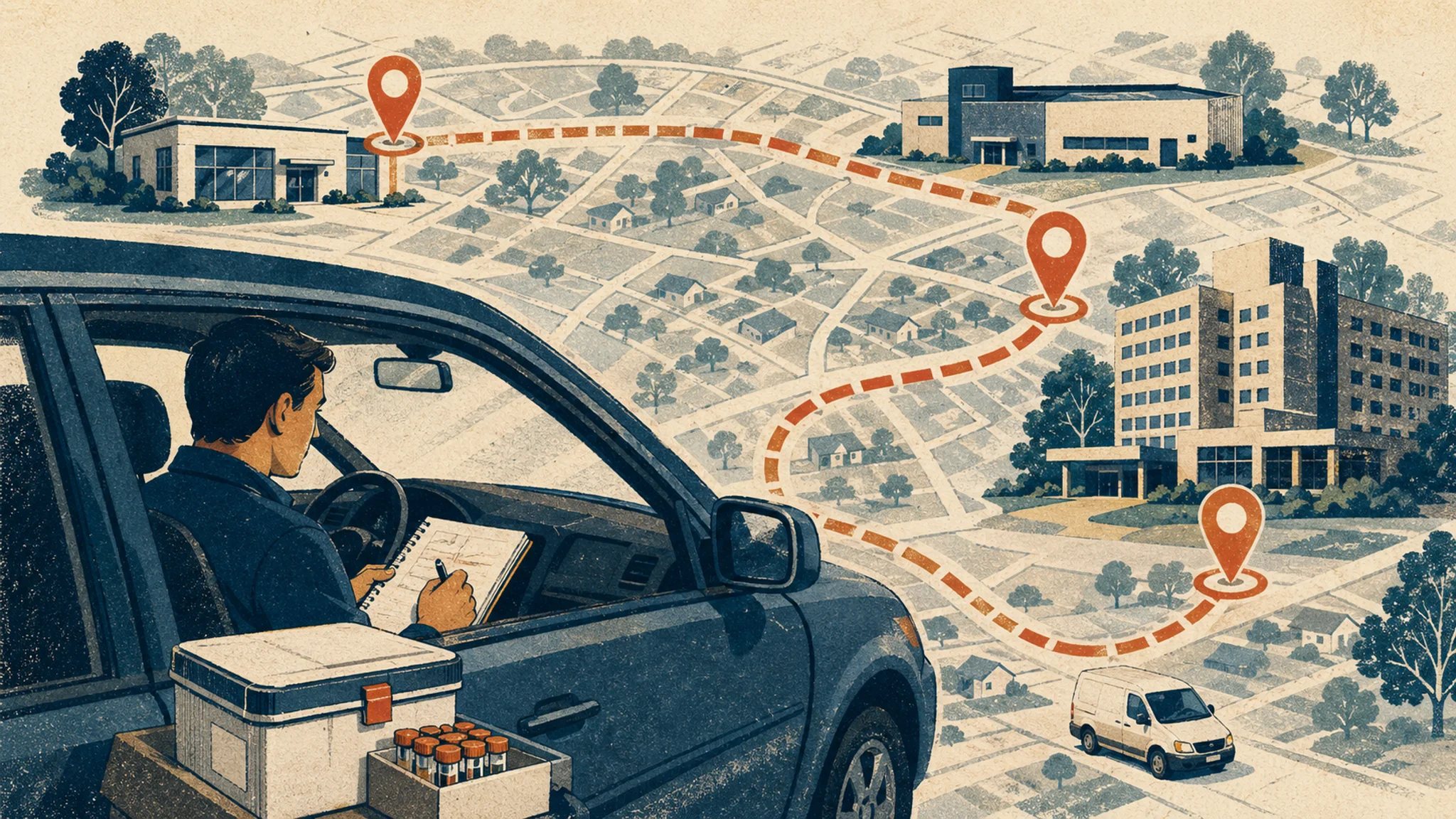
Lab sales territory planning 2026 is less about drawing a tidy map and more about protecting the few windows that move accounts. Sales route optimization is the practice of sequencing account visits, drive legs, and time constraints so a rep spends less time rebuilding the day and more time advancing qualified lab relationships.
This post is for laboratory sales reps, clinical lab reps, diagnostic sales reps, reference lab reps, POL sellers, and lab sales managers who still work real territory loops. If your facility list is ready but the route order is eating the morning, see how MedRoute for lab sales reps turns that list into a faster field plan.
TL;DR
- Lab routes now have to account for access windows, not just mileage.
- Specimen kits, pickup expectations, and result follow-up can dictate stop order.
- POL and urgent care loops work best when short visits are batched.
- Saved routes matter because the same territory comes back every week.
Table of contents
- What is lab sales territory planning 2026?
- Why the lab route is tighter now
- The 2026 lab sales territory loop
- Copyable route audit for lab reps
- Where MedRoute fits
What is lab sales territory planning 2026?
Lab sales territory planning is the weekly operating plan for which facilities a rep will cover, which accounts deserve priority, which stops can move, and how the route should change when office access or sample logistics shift. In 2026, the best plan starts with constraints: lab director availability, POL office-manager windows, courier handoffs, standing call-backs, and accounts that need activation.
A closest-first route still looks efficient on paper. It breaks when the priority hospital lab only has a 9:30 a.m. window, the POL needs kit support before lunch, and the reference lab wants a follow-up tied to yesterday's accession volume.
What is lab sales territory planning in 2026? It is the field plan that tells a lab rep which accounts to see, in what order, and why that order protects access, specimen logistics, and follow-up. The U.S. Bureau of Labor Statistics notes that wholesale and manufacturing sales representatives often spend much of their time traveling to current customers and prospective buyers, and lab reps live that pattern with more constraints. A POL drop-in may take 10 minutes, a hospital lab director conversation may take 35 minutes, and a reference lab follow-up may depend on courier timing. MedRoute matters when the rep already knows the account list but needs a cleaner route loop: fixed windows stay fixed, flexible stops get reordered, and the day has fewer parking-lot decisions. That matters most when one missed window pushes five nearby stops out of order.
Why the lab route is tighter now
The first shift is access. A lab rep may have the right account on the list, but the wrong arrival time can turn a real visit into a polite front-desk pass. Hospital lab directors have meetings. POL staff get buried when patient volume stacks up. Urgent care managers may only have five clean minutes between rushes.
The second shift is specimen logistics. Lab sales is not only "drop by and sell." A rep may need to check kit levels, clarify a pickup issue, confirm a result follow-up, or reset an account that stopped sending volume. Those details change the order of the day.
Try a rep-built route loop
MedRoute is browser-based, built by field reps, and made for recurring multi-stop territory days.
See how MedRoute worksWhy do specimen logistics change lab sales routing? Specimen logistics change routing because a visit is not just a conversation; it can include kit placement, pickup expectations, result follow-up, and courier timing. CMS explains that the Clinical Laboratory Improvement Amendments apply to laboratories that test human specimens for diagnosis, prevention, or treatment, which is why lab reps often sell into accounts with real operational constraints. A physician-office lab may need waived-test kit support before lunch. A reference lab may care about accession volume and pickup reliability. A hospital lab director may only have a narrow operations window. The route has to respect those differences before mileage is optimized. MedRoute helps when those stop types are already known and the rep needs to turn them into a repeatable loop. In 2026, the better route is the one that protects both selling time and sample flow.
The 2026 lab sales territory loop
A modern lab-sales loop is not one giant route. It is a set of repeatable patterns: a POL morning, a hospital-lab window, a reference-lab follow-up block, and a flexible account activation sweep. You can still optimize drive time, but only after those business rules are clear.
| Loop segment | Best-fit account type | Field signal | Route move |
|---|---|---|---|
| First fixed stop | Hospital lab or high-value reference lab | Lab director window, decision-maker access | Lock it before optimizing the rest |
| Short-visit cluster | POLs, urgent cares, specialty clinics | Kit check, office-manager follow-up | Batch 3 to 5 nearby stops |
| Operational follow-up | Reference lab or active account | Pickup, accession, or result issue | Place before the cutoff window |
| Flexible sweep | New account activation targets | No fixed appointment, real upside | Let optimization decide the order |
That pattern lines up with the route batching advice in the MedRoute Academy guide to four lab accounts in one morning. The account type matters because each stop burns a different kind of energy.
How should a lab rep use route optimization in 2026? Use route optimization after the business rules are clear, not before. Google explains that waypoint optimization can reorder intermediate stops for a more efficient route, with documented limits that depend on waypoint type. That is useful, but it does not know which POL visit must happen before the courier pickup or which hospital lab director is available only at 9:30 a.m. A rep-built workflow starts with fixed appointments, kit or sample constraints, and account priority. Then the flexible stops can move. MedRoute is built on Google Maps directions and waypoint optimization, supports large routes in chunks around 25 waypoints, and still lets the rep drag stops when field judgment beats the default order. That balance keeps optimization from turning an important clinical account into an inconvenient detour.
Copyable route audit for lab reps
Use this audit before Monday, or any morning when the plan changes at 7:15 a.m. It is small on purpose. If it takes 45 minutes, you will stop using it by Wednesday.
Lab sales route audit
Date:
Territory segment:
Fixed windows:
- Account:
- Time:
- Why fixed:

Specimen or kit constraints:
- Kit drop:
- Pickup issue:
- Result follow-up:
- Courier cutoff:

Priority accounts:
1.
2.
3.

Flexible stops:
- POLs:
- Urgent cares:
- Reference labs:
- New activation targets:

Route decision:
- Save as recurring loop? Yes / No
- What changed from last time?
- What should the manager know?
Pair that audit with the daily lab sales KPI checklist. Completed visits, follow-up booked, and new account activation are cleaner when the route did not waste the best office window.
Where MedRoute fits
MedRoute is the route optimization tool built by field reps, for field reps. It is useful when a lab rep has a facility list and needs the fastest practical route without paying for a heavy enterprise mapping stack or rebuilding the same loop in Google Maps every week.
| Need | Spreadsheet plus map habit | MedRoute |
|---|---|---|
| More than a small stop list | Split by hand and hope the order works | Build large routes in optimized chunks |
| Priority stop changes | Rebuild the route from scratch | Drag and drop the stop order |
| Recurring territory loop | Start over each week | Save and reload routes that work |
| Manager visibility | Ask reps to send screenshots or spreadsheets | Use admin reports for route activity |
For a broader set of repeatable field routines, build the same habit into every territory workflow. The point is not to make planning fancy. The point is to make tomorrow's field day easier to run.
The bottom line
Lab sales territory planning in 2026 is tighter because access, sample logistics, and recurring follow-up all compete for the same day. Start with fixed windows, batch similar account types, optimize the flexible stops, and save the loops that work. When you are ready to turn tomorrow's facility list into a real route, build the loop in MedRoute.
Frequently asked questions
What changed in lab sales territory planning in 2026?
The biggest change is that reps have less slack. Access windows are narrower, POL follow-up moves faster, and sample logistics can change the order of the day. A good plan now starts with fixed account constraints, then optimizes flexible stops around them.
How should lab reps plan routes around specimen logistics?
Put kit drops, pickup expectations, courier cutoffs, and result follow-ups on the route before general drop-ins. Then cluster nearby POLs, urgent cares, and reference lab stops. The goal is to protect sample flow without letting one operational errand consume the best selling window.
What is the best route loop for POL and reference lab reps?
The best loop starts with the fixed or highest-value account, then batches similar short visits nearby. For many reps, that means a POL cluster before lunch, one reference lab follow-up, and flexible drop-ins saved for route gaps after priority stops.
About the author
Brandon Worley
Brandon Worley is the founder of MedRoute AI. He carried a territory as a field medical sales rep, then built and ran a 450-person medical sales team. Today he trains medical sales reps and teams full-time, and built MedRoute from the pain points he and the reps he trains experienced in the field every day.
Connect on LinkedInKeep reading
Lab Sales Route Planning vs Google Maps
A practical comparison for lab reps deciding when Google Maps is enough and when a field-sales route planner is the better fit for territory days.
ReadRoute PlanningGoogle Maps Stop Limit Lab Sales Reps Hit
A practical guide for lab reps who hit the Google Maps stop limit and need to split, optimize, and save bigger territory routes without losing account priority.
ReadWant these tactics easier to execute?
MedRoute AI is the tool Brandon built to make every tactic in this library 10x easier.